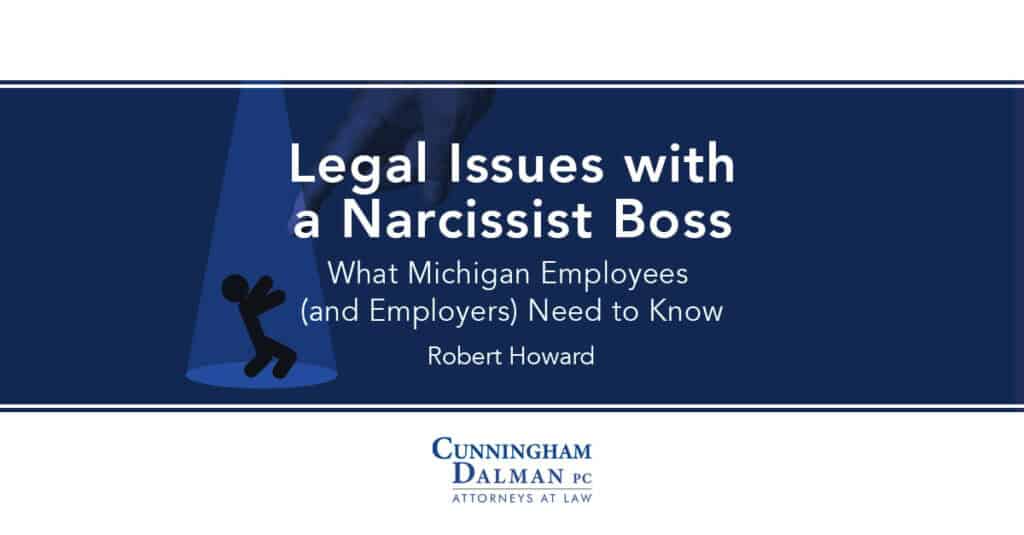
As an employment attorney in Michigan, I am often asked whether a “narcissist boss” can create legal liability. The short answer is: sometimes—but not always. Many toxic behaviors are deeply harmful, yet not automatically unlawful. Understanding the difference between bad management and illegal conduct is critical for both employees and employers.
What Does a “Narcissist Boss” Look Like?
While “narcissism” is a psychological term—not a legal one—employees often use it to describe supervisors who:
- Constantly seek praise and take credit for others’ work
- Blame subordinates for their own mistakes
- Publicly demean or humiliate employees
- Rewrite history to protect their image
- Retaliate when challenged
- Create chaos to maintain control
These behaviors may create a toxic workplace. But toxicity alone does not equal illegality.
Gaslighting Is Not Illegal (By Itself)
“Gaslighting” refers to manipulating someone into doubting their own perception of reality—for example:
- Denying statements previously made
- Claiming an employee “misunderstood” clear instructions
- Rewriting events to portray the employee as incompetent
- Telling an employee that others think they are “unstable”
As damaging as gaslighting can be, it is not illegal on its own. Michigan and federal employment laws do not prohibit manipulation, dishonesty, or unfairness in the abstract. Unless the conduct is tied to unlawful discrimination, harassment, or retaliation, it typically does not create a viable legal claim.
Workplace Bullying: When Is It Illegal?
Michigan does not have a general anti-bullying statute for private employment. Bullying becomes unlawful only when it is connected to:
- A protected status
- A protected activity
Protected Status
Under Michigan’s Elliott-Larsen Civil Rights Act and federal law, employers may not discriminate or harass employees based on certain legally protected characteristics. In Michigan, these include:
- Race
- Color
- Religion
- National origin
- Sex (including pregnancy, sexual orientation, and gender identity)
- Age (40+)
- Disability
- Height
- Weight
- Marital status
If a manager targets an employee because of one of these characteristics—and the conduct is severe or pervasive enough to create a hostile work environment—that may be unlawful harassment.
Protected Activity
Employees are also protected from retaliation when they engage in legally protected activities, such as:
- Reporting discrimination or harassment
- Filing a complaint with HR
- Participating in an internal investigation
- Filing a charge with the EEOC or Michigan Department of Civil Rights
- Requesting a reasonable accommodation (disability or religion)
- Taking FMLA leave
- Reporting wage violations
Whistleblowing under Michigan’s Whistleblowers’ Protection Act
If negative treatment occurs because an employee engaged in protected activity, that may constitute unlawful retaliation—even if the original complaint ultimately lacks merit.
Hostile Work Environment: The Legal Standard
For conduct to rise to the level of a legally actionable hostile work environment, it must be based on a protected status and severe or pervasive enough to alter the conditions of employment. Occasional rude comments, micromanagement, or favoritism generally do not meet this threshold.
Constructive Discharge: When Quitting Becomes a Legal Claim
If working conditions become so intolerable that a reasonable person would feel compelled to resign, an employee may claim constructive discharge. However, the underlying conduct must still be unlawful. A toxic personality alone does not convert a resignation into a lawsuit.
Employer Risk: Why This Still Matters
Even when behavior does not violate a statute, it still creates significant risk, including:
- Increased turnover
- Poor morale
- Burnout and stress claims
- Workers’ compensation filings
- Reputational damage
- Escalation into discrimination or retaliation claims
Practical Guidance for Employees
- Document specific incidents with dates and witnesses
- Note any connection to protected status or protected activity
- Use internal complaint procedures when appropriate
- Avoid emotional confrontations that can be reframed against you
- Consult counsel before resigning if you believe conduct is unlawful
Practical Guidance for Employers
- Train managers on anti-discrimination and anti-retaliation laws
- Enforce consistent disciplinary practices
- Investigate complaints promptly and objectively
- Separate personality conflicts from protected-status concerns
- Monitor high-conflict leadership styles before they create liability
Bottom Line
Not all bad behavior is illegal. Gaslighting is harmful—but not unlawful by itself. Bullying becomes illegal only when tied to a protected status or protected activity. The legal question is not whether a boss is narcissistic, but whether the conduct violates Michigan or federal employment law.